Here is the weird thing about A&W: Canada turned it into a fast-food success story. America practically forgot it existed. In Canada, A&W means Teen Burgers, the Burger Family and frosty mugs of root beer. Its restaurants are modern, busy and scattered from city streets to highway stops. In the United States, the same name can feel like a trip through a time machine. An A&W might be an aging roadside restaurant or a counter tucked inside a KFC, a leftover from the drive-in era. Same name, same root beer, same beginnings. And the strangest part? A&W was once bigger than McDonald’s in America. So how did a burger chain that once had 2,400 locations end up becoming a Canadian institution instead?
A&W’s story actually begins with root beer. Roy W. Allen opened a roadside root beer stand in Lodi, California, in 1919. Allen partnered with Frank Wright, and the first A&W restaurant opened in Sacramento in 1923. From there, the company became one of America’s pioneering franchise restaurant chains, eventually spreading A&W restaurants across the country and turning a simple root beer stand into a major piece of American fast-food history.
By the 1970s, A&W had become enormous. The chain peaked at about 2,400 U.S. locations in 1974, at one point outnumbering McDonald’s. The problem was that A&W was heavily tied to the drive-in model, with carhops and roadside restaurants built around a very different idea of fast food. As Americans shifted toward standardized restaurants, drive-thrus and quicker counter service, A&W struggled to reinvent itself. McDonald’s adapted and expanded while A&W was still trying to figure out what its next act should be.
Then came the split that changed everything. In 1972, A&W’s Canadian operation was sold to Unilever and separated from the American business. More than two decades later, in 1995, Canadian management bought the company back, putting the Canadian operation firmly in local hands. From that point forward, the two A&Ws were no longer simply branches of the same business. They were independent companies making their own decisions about what the brand should become.
That difference in ownership helped send them in very different directions. In the United States, A&W eventually passed through several corporate owners, including Yum! Brands, before being bought by its franchisees in 2011. The American chain survived, but its footprint became a fraction of what it had been during its glory days. Canada, meanwhile, had something much closer to a clean slate and used it to turn A&W into a distinctly Canadian restaurant brand.
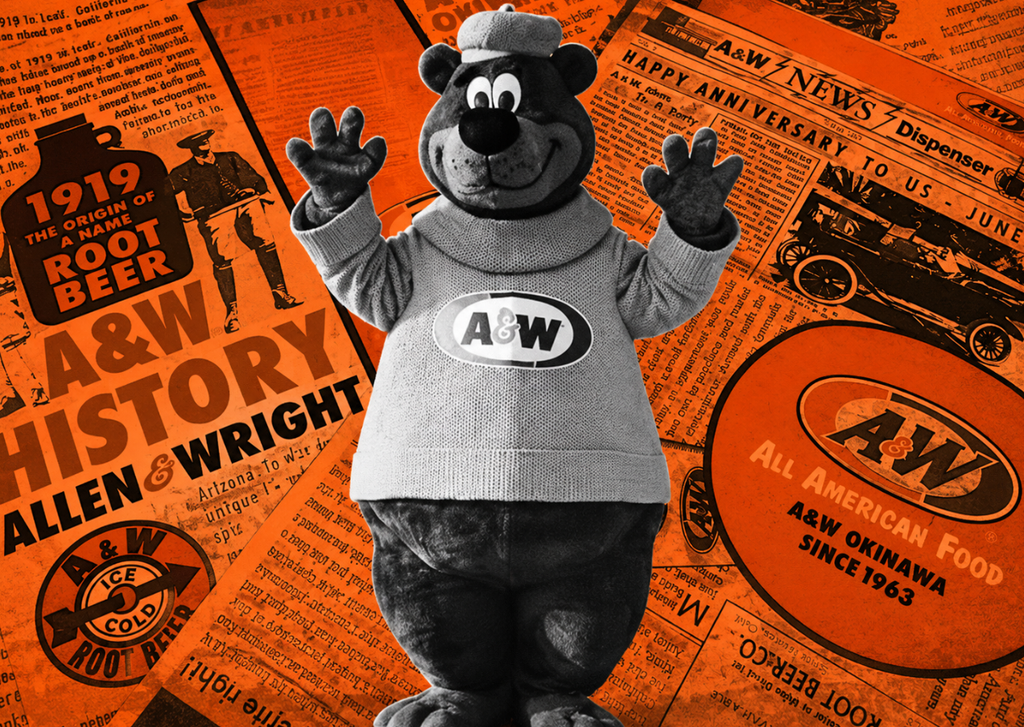
Canada changed with the times without throwing away the things customers already loved. The old drive-ins gave way to contemporary restaurants, suburban locations and highway stops with drive-thrus, while the frosty mugs and Burger Family remained part of the experience. Then came the Great Root Bear. In 1975, A&W Canada introduced the orange-clad bear in its “Follow the Great Root Bear to A&W” advertising as competition from McDonald’s and other fast-food chains was heating up. The character gave the Canadian operation something the American chain could not simply copy: a personality of its own. The bear became a long-running part of A&W Canada’s identity and eventually one of the most recognizable mascots in Canadian fast food.
A&W Canada now has more than 1,100 restaurants across the country, and the company has made food quality part of its identity, emphasizing grass-fed beef raised without hormones or steroids, chicken raised without antibiotics and organic coffee. In 2018, it became the first national burger chain in Canada to put the Beyond Burger on its menu nationwide.
And then there is the Burger Family, perhaps the simplest stroke of branding in Canadian fast food. Teen Burger, Mama Burger, Papa Burger, Grandpa Burger and Baby Burger are almost ridiculously easy to understand. You do not need to decode a menu or figure out which burger is supposed to be the signature item. The names became familiar, memorable and distinctly A&W, giving the Canadian chain an identity that went far beyond its root beer.
That may be the real secret of A&W’s Canadian success. Canada did not save A&W by keeping it in the past. It saved it by figuring out what was worth keeping and what needed to change. The Americans had the same name, the same root beer and the same century-old head start, but Canada figured out how to turn that history into something people still wanted. Sometimes the best way to save an old brand is not to make it young. It’s to make people want it again.
Nibbles: A&W’s first Canadian drive-in opened in Winnipeg in 1956. Today, the Canadian chain has more than 1,100 restaurants.
Discover more from Grubbits
Subscribe to get the latest posts sent to your email.