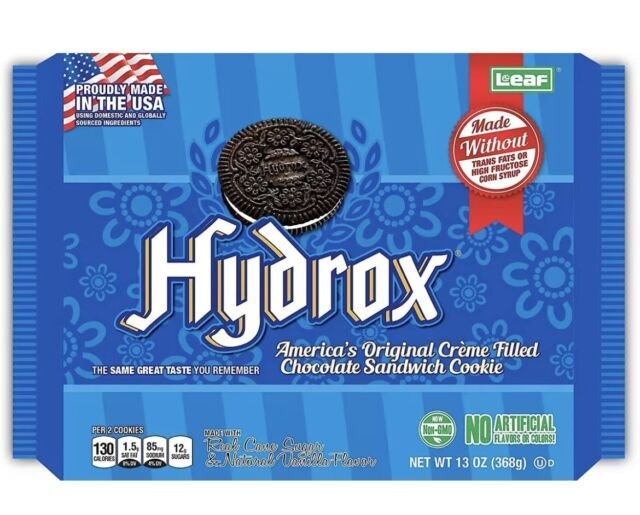
If you grew up eating Oreo cookies, there is a good chance you have never thought of them as the younger sibling. Oreo is one of those food brands that feels as though it has simply always existed. The dark chocolate cookies, sweet creme filling, familiar twist, and unmistakable name have become part of snack culture. But Oreo was not the first cookie to put chocolate wafers around a sweet creme center.
That distinction belongs to Hydrox.
Hydrox was introduced in 1908 by the Loose-Wiles Biscuit Company, later known as Sunshine Biscuits. Four years later, in 1912, Nabisco introduced Oreo. The two cookies looked remarkably similar, and Oreo eventually became so much more famous that the history was almost completely turned upside down in the public imagination. Today, plenty of people could look at a package of Hydrox and assume somebody was trying to make an Oreo knockoff.
The supposed knockoff was there first.
That makes the story considerably more interesting because Hydrox was not some obscure experimental cookie that disappeared after a few months. It was an established product with a genuine head start. The name itself was intended to suggest purity and goodness, drawing from hydrogen and oxygen, the elements that make up water. Unfortunately, “Hydrox” does not exactly sound like the name of something you want to dunk into a glass of milk. It sounds a little more like something you might find underneath the kitchen sink.
Oreo had the better-known name, the bigger company behind it, and eventually the much stronger marketing machine. Over time, Oreo became the cookie everyone recognized, while Hydrox became the one people had to explain. That is quite a reversal for a product that had arrived on store shelves four years earlier.
Imagine creating a product before your better-known competitor, only to spend the next century being remembered by many people as the imitation. Food history is full of forgotten originals, but the Hydrox story may be one of the more amusing examples because the two products remain so closely associated with each other.
Hydrox eventually disappeared from store shelves after a complicated series of ownership changes. Sunshine Biscuits was acquired by Keebler in 1996, and Hydrox was replaced in 1999 by a reformulated cookie called Droxies. The Hydrox name eventually disappeared from the shelves, although the cookie was briefly brought back for its 100th anniversary in 2008.
Then the original sandwich cookie made another comeback.
Leaf Brands acquired the Hydrox trademark and relaunched the cookies in 2015. The company positioned Hydrox as the original sandwich cookie and emphasized its place in the history that came before Oreo. The revived cookie also gave consumers another opportunity to compare the two products, with Hydrox promoting a crunchier texture and a less-sweet filling.
The branding question is perhaps the most fascinating part of the whole story. A product name can shape how consumers feel about something before they ever taste it. “Oreo” is short, memorable, and easy to say. “Hydrox” was created with a completely different idea in mind, but decades of hindsight make the name sound strangely industrial.
That does not mean the name alone doomed Hydrox. Marketing, distribution, corporate ownership, product changes, and consumer habits all played roles in determining which cookie became the cultural giant. Still, it is hard not to wonder what might have happened if the original had arrived with a name that was just as memorable as its competitor’s.
There is something wonderfully strange about this entire story. We often assume the most famous product must have been the original because familiarity can feel like proof of precedence. Sometimes the opposite is true. A competitor can arrive later, build a stronger identity, market itself more effectively, and eventually become so dominant that people forget who came first.
That may be the biggest lesson in the Hydrox story. Being first does not guarantee that people will remember you as the original. A great product matters, but so do the name, packaging, marketing, distribution, and the memories consumers build around a brand.
So the next time someone tells you Oreo invented the chocolate sandwich cookie, there is a little food-history plot twist worth sharing.
Hydrox got there four years earlier.
And somehow, the original became the copycat.
Nibbles
Hydrox had the ultimate food-branding problem: it was the original, but its name sounded like something you might use to clean your kitchen.
Discover more from Grubbits
Subscribe to get the latest posts sent to your email.