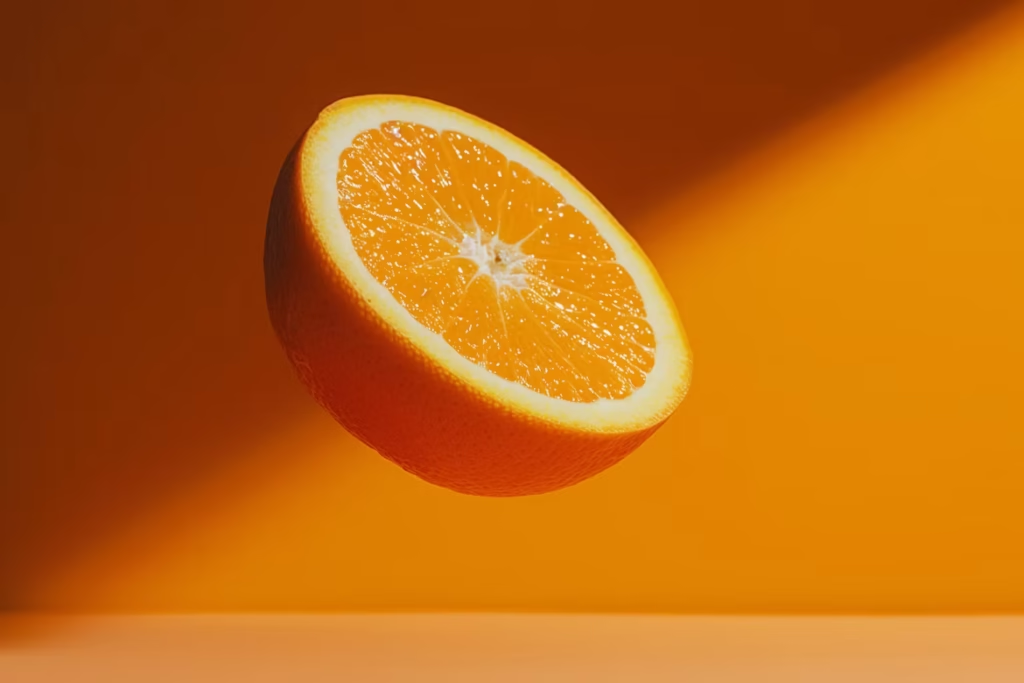
An orange is called an orange because a piece of fruit took a very long road trip across several languages and eventually hijacked an entire section of the English language. Before the fruit arrived in Europe, English had no standard word for that bright shade. People could describe similar colors as yellow-red, saffron, gold or reddish-yellow, but orange was not yet sitting in the crayon box.
The word itself has a surprisingly complicated passport. It ultimately traces back to the Sanskrit nāraṅga, a word for the orange tree. From there it moved through Persian as nārang and Arabic as nāranj, before making its way into European languages. Old French used forms such as pume orenge. Somewhere along this journey, the initial N disappeared. Linguists call this rebracketing, when a sound gets attached to the wrong word. It is the same kind of linguistic oddity that helped turn “a napron” into “an apron.”
English borrowed the N-less form and began using “orange” for the fruit during the Middle Ages. The color came later. The earliest recorded English use of “orange” as a color name dates to 1502, with another early example appearing in 1512. The fruit got naming rights first, then the color showed up fashionably late.
That created some wonderfully confusing leftovers. Redheads, red foxes and robin redbreasts had already been named long before “orange” became a standard color word, so they were stuck with “red.” Language had already filed the paperwork and apparently refused to reopen the case.
A Clockwork Orange, Anthony Burgess’s 1962 novel later turned into Stanley Kubrick’s famous 1971 film, has one of the strangest titles involving a piece of fruit. Burgess said he had heard the phrase “as queer as a clockwork orange” in a London pub and used it for his book. The story behind the phrase is disputed, however, because no independent record of it being used before the novel has been found. Burgess also explained the title as a collision between something organic, living and juicy and something mechanical. Either way, the orange had officially escaped the produce aisle.
The fruit itself is just as interesting. The sweet orange, Citrus sinensis, has mandarin and pomelo ancestry and comes from ancient citrus hybridization followed by generations of cultivation and selection. So that supermarket orange has a considerably more complicated family tree than its cheerful appearance suggests.
Then there is the green-orange problem. In tropical climates, an orange can be fully mature while its peel remains green because warm conditions allow chlorophyll to persist in the rind. Cooler temperatures encourage that pigment to break down, revealing the familiar orange color. A green orange, therefore, is not automatically an unripe orange. Sometimes it is simply an orange living somewhere that refuses to give it the wardrobe we expect.
And that brilliant color has become useful far beyond the produce aisle. Aircraft flight recorders, popularly called “black boxes,” are actually painted orange because the color makes them easier to locate after an accident. The Golden Gate Bridge also uses International Orange, helping it stand out against San Francisco’s surroundings.
So the next time you peel an orange, remember what you are holding. It is a hybrid citrus fruit with an international family history, a name that lost an N, a starring role in pop culture and a color that borrowed its name from the fruit. Not bad for something you usually eat over the kitchen sink.
Nibbles: One orange can contain hundreds of tiny oil-filled glands in its peel. That fresh citrus smell is basically the fruit’s skin releasing perfume.
Discover more from Grubbits
Subscribe to get the latest posts sent to your email.