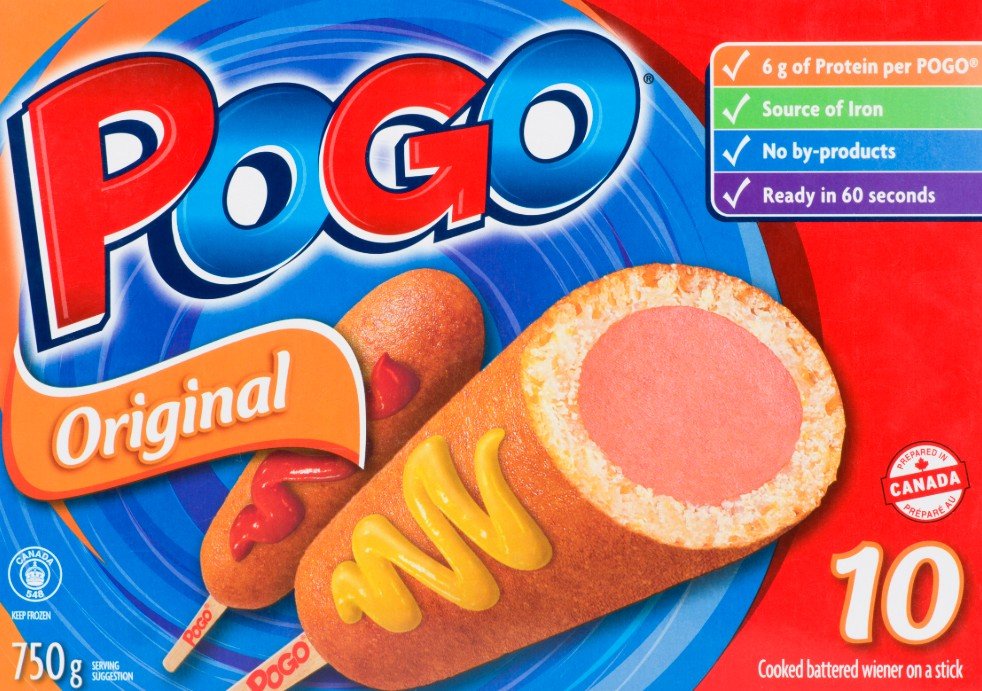
You pull a golden, battered hot dog on a stick out of the freezer, throw it in the oven, and call it a corn dog. But if you grew up north of the border, that name probably sounds a little too formal, almost clinical. To generations of Canadians, that snack is, and always will be, a Pogo.
That is what makes the Pogo story more interesting than it first appears. This wasn’t simply a successful frozen-food brand. At some point, the brand name escaped the package and became part of the Canadian vocabulary. The Dictionary of Canadianisms lists pogo as a Canadian term for a battered, deep-fried hot dog served on a stick, which means Canadians didn’t just buy Pogos. We started calling the food itself a Pogo.
The history goes back to Leopold P. Kerr of Duvernay, Quebec. The Canadian trademark record shows that POGO was filed in September 1966 and registered in June 1967. But here is the part I like: the same record says the mark had already been used in Canada as early as January 1964. So Pogo was already a thing before the trademark paperwork officially caught up with it.
The brand eventually passed through other companies before becoming part of ConAgra’s Canadian business. Today, Conagra still describes POGO as Canada’s number one-selling corn dog brand, based on 2024 Canadian retail dollar sales. That is an impressive run for something that spends most of its life sitting in a freezer.
But the sales aren’t really the fascinating part. The fascinating part is what happened to the name, because Pogo managed to do something that most food brands never accomplish. It became bigger than the product sitting inside the package.
In the United States, this thing is generally a corn dog. You see them at fairs, carnivals, amusement parks and sporting events, usually coming out of a fryer while somebody tries not to burn the roof of their mouth. The name tells you exactly what you are getting: a hot dog covered in cornmeal batter.
In Canada, Pogo became the shortcut. For countless Canadian kids, you could open the freezer, find the yellow box and know exactly what was inside. You didn’t need to say corn dog because saying you were having a Pogo was enough for everybody to understand what you meant.
That is a pretty powerful thing for a brand to accomplish. The product doesn’t have to explain itself anymore because the brand name has become part of everyday language.
There are plenty of examples of trademarks becoming everyday words. Kleenex is probably the most obvious one, while Dumpster is another. But Pogo has its own particularly Canadian twist because the brand name became associated with an entire food category. Canada’s federal terminology database even describes Pogo as the trade name commonly known in Canada for a corn dog.
The name itself certainly seems to have some playful mid-century logic behind it. A pogo stick and a battered hot dog on a stick don’t have much in common beyond the stick, but the name has the right kind of bouncy, slightly ridiculous energy for a snack like this. I wouldn’t claim that is definitely where the name came from without better evidence, but it certainly feels appropriate.
And corn dog does sound a little technical by comparison. Hot dog, cornmeal batter, deep fryer and stick. Pogo sounds like something you actually want to eat, which might be part of the reason the name stuck so well.
The same basic food has its own collection of names around the world. In Australia, for example, you can run into Dagwood Dogs and Pluto Pups at fairs and other events. Different name, different country, same basic formula: sausage, batter and a stick.
But Canada did something a little different with it. We took a brand name and turned it into vocabulary, and that is what makes the humble Pogo more interesting than it looks when you pull one out of the freezer.
That may be the real story behind the Pogo. It isn’t just a frozen corn dog that became popular in Canada. It is a reminder that sometimes a brand can become so familiar that the name on the box becomes the word everyone uses for what is inside.
The corn dog didn’t disappear in Canada. We just gave it a name of our own, and after all these years, most of us aren’t giving it back.
Nibbles: In Canada, “pogo” escaped its trademark origins and became a generic word for a corn dog. Linguists call this kind of word change semantic change.
Discover more from Grubbits
Subscribe to get the latest posts sent to your email.